
Safety first. This is general information, not medical advice and not a substitute for your coach. Atlas has not trained at these gyms and has no firsthand sparring experience to report. If you have a medical condition, check with a doctor before sparring.
The short answer
Spar when your coach says you are ready, in the kit the gym asks for, with a partner who has agreed the intensity. Treat the first session as a technical practice, not a test. And if anyone takes a knock to the head, stop, tell the coach, and follow the guidance below.
Are you ready? (a checklist to take to your coach)
This is Atlas editorial guidance, not a standard. Ask your coach to confirm each point:
- You can hold a basic stance and guard and move without freezing (see stance and footwork).
- You know a few defensive tools: blocks and the shin check (see checking and blocking kicks).
- You have the kit the gym requires (below).
- You know who your partner is and have agreed light contact.
- You have told the coach about injuries, health conditions and any recent head knocks.
What gyms say
- 8 Limbs (Birmingham): its FAQ says sparring kit is needed from the yellow band (page read 2 Oct 2026). It does not give a time.
- Diesel Gym (London): says new members need 14oz or above boxing gloves to start (page read 2 Oct 2026).
- Atlas guide: most gyms keep new members out of sparring until the coach thinks they are ready, and in the first class you do not usually spar.
In Thai gyms, the Atlas glossary says sparring is typically light and playful, aiming to sharpen timing rather than win. Competition rules are separate; IFMA's semi-contact division, for example, uses controlled, light contact and prohibits full-power strikes (IFMA 31.3.1).
Kit
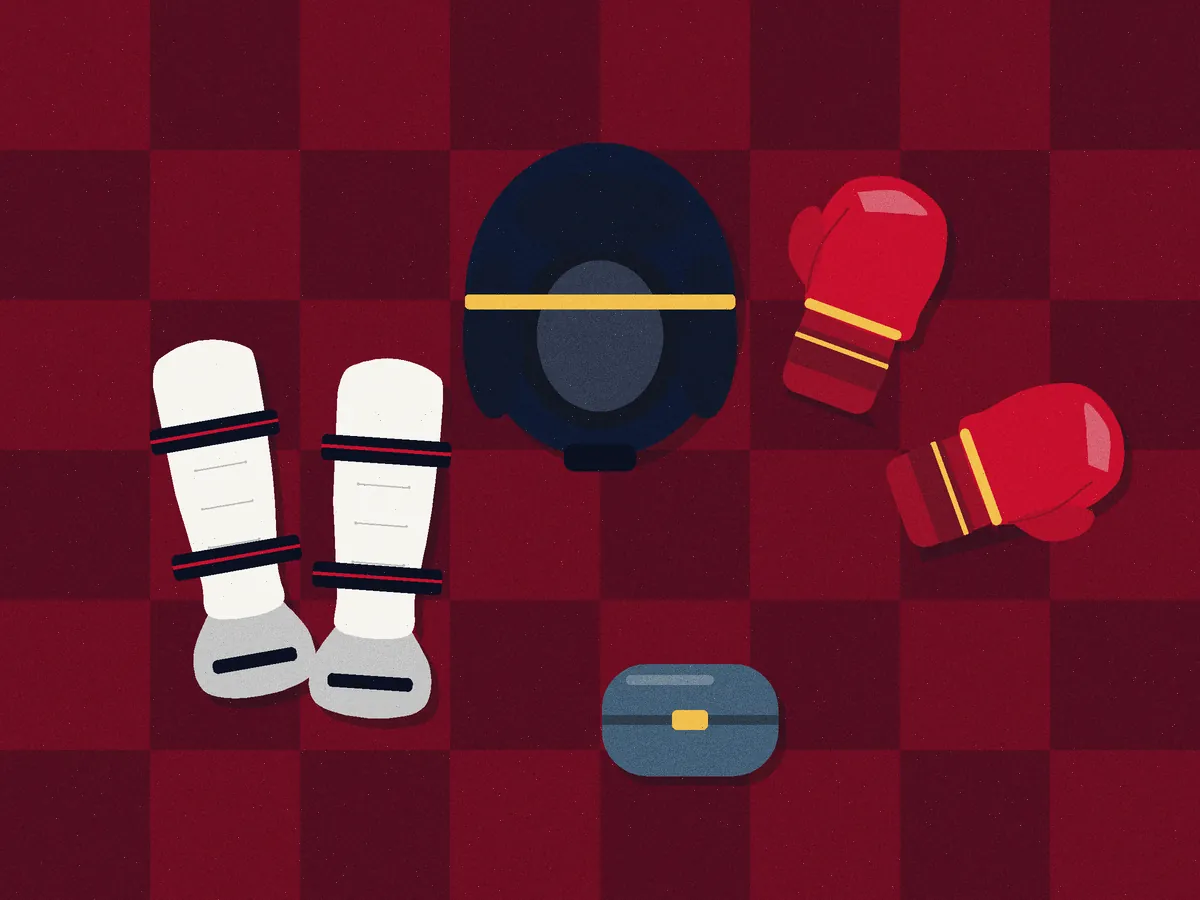
See the kit list for the full stage-by-stage version. For sparring most UK gyms ask for 16oz gloves (heavier members sometimes 18oz), hand wraps, a gum shield and shin guards, plus a groin guard. Ask your coach what yours requires; see what oz gloves for Muay Thai.
Agree the intensity
Before the bell, say it out loud: "light, technical, no hard kicks to the body, no head shots." Agree what to do if one of you wants to slow down. Ask your coach to pair you with a partner who can control contact.
What coaches tend to watch
We do not have a study to cite here, so treat these as questions to ask your coach, not as findings:
- Are you keeping your guard up when you are tired?
- Are you breathing and staying relaxed?
- Are you moving your feet or standing still?
- Are you able to stop when told?
Head knocks: what NHS and UK guidance say
The UK Concussion Guidelines for Non-Elite (Grassroots) Sport (November 2024) say:
- Anyone suspected of concussion must be removed from play or training immediately: "If in doubt, sit them out."
- No one should return to competition, training or PE within 24 hours of a suspected concussion.
- Get assessed by a healthcare professional or via NHS 111 within 24 hours; for red flags, urgent medical help (999 if necessary).
- Generally rest for 24-48 hours, then follow a graduated return to activity.
- No return to competition before 21 days from injury.
The NHS page on head injury and concussion (last reviewed 29 May 2025) lists symptoms that need a 999 call and says that after a minor head injury you should not play contact sports for at least 3 weeks. The two sets of advice differ in their timings, so ask a clinician and follow the stricter advice for your case.
After your first spar
Tell the coach how it felt. Note anything that hurts. If you feel unwell later, that day or the next, stop training and get advice. See your first month of Muay Thai for how to build up, and interclub to first fight if competition is your goal.
Sources and dates
- UK Concussion Guidelines for Non-Elite (Grassroots) Sport, November 2024 · remove from play, 24-hour assessment, 24-48h rest, graduated return, no return to competition before 21 days · read 2 Oct 2026
- NHS: head injury and concussion · page last reviewed 29 May 2025, next review 29 May 2028; 999/111 advice; no contact sports for at least 3 weeks after a minor head injury · read 2 Oct 2026
- 8 Limbs Birmingham: FAQ · sparring kit from yellow band · read 2 Oct 2026
- Diesel Gym: timetables and prices · gloves 14oz or above to start · read 2 Oct 2026
- Atlas guide: Muay Thai for beginners (UK) · beginners don't usually spar in the first class (Atlas editorial, 28 Sep 2026) · read 2 Oct 2026
- Atlas glossary: sparring · Thai sparring is typically light and playful · read 2 Oct 2026
- IFMA Rules and Regulations v3.057 (11 May 2026) · 31.3.1 semi-contact: controlled, light contact; full-power strikes prohibited · read 2 Oct 2026
FAQs
When should a beginner start sparring in Muay Thai?
When your coach says so. Gyms set their own rules: 8 Limbs Birmingham's FAQ says sparring kit is needed from the yellow band, and most gyms keep new members out of sparring until the coach thinks they are ready (Atlas beginner guide). We cannot give a number of weeks.
Do I have to spar?
Not necessarily. Many people train for fitness and never spar. Ask your gym whether sparring is optional and whether there are technical or light-contact options.
What kit do I need for sparring?
Usually 16oz gloves, hand wraps, a gum shield and shin guards, plus a groin guard. Gyms differ, so ask your coach. See our kit list.
What should I do after a knock to the head?
Stop and tell your coach. The UK grassroots concussion guidelines (Nov 2024) say 'if in doubt, sit them out', do not return to training within 24 hours of a suspected concussion and get assessed by a healthcare professional or NHS 111 within 24 hours. NHS advice for a minor head injury is not to play contact sports for at least 3 weeks. Call 999 for the red-flag symptoms the NHS lists.
Is light sparring safe?
No contact sport is risk-free. Lighter, controlled sparring with a partner who matches your level is the usual way gyms manage risk, but we cannot guarantee safety. If you have a medical condition, check with a doctor first.